Paper, Cloth or Board: Choosing a Surface for a Collage
Choose a collage surface by matching texture, flexibility, and edge behavior to your materials, so the finished arrangement feels deliberate rather than forced.
The most common mistake in choosing a collage surface is reaching for whatever lies flat on the table. A thin sheet can buckle under damp adhesive, cloth can soften a crisp arrangement, and heavy board can make delicate scraps look stranded. Choosing a surface for a collage is less about finding a neutral base than deciding what role its texture, flexibility, and edges should play.
Give the decision a short working week rather than settling it by instinct. Each day, examine one quality, then make a small trial before committing the full arrangement. The routine suits a collage made from paper, fabric, or card; it does not require special equipment beyond scraps, scissors, a pencil, and the adhesive intended for the finished work.
Monday reveals what the materials are asking for
Gather the actual pieces planned for the collage. Include the thinnest paper, the most open-weave fabric, and any stiff or layered scraps. Surface choice depends on this mix: a base that behaves well under one clean paper cut may struggle once a soft textile and several pasted layers join in.
Lay the pieces loosely on three candidate surfaces: paper, cloth, and board. Do not glue them yet. Notice whether the arrangement feels airy, weighty, orderly, or soft before the base begins to compete with it. The surface is not merely a support; it supplies a visual ground and can change how the scraps seem to belong together.
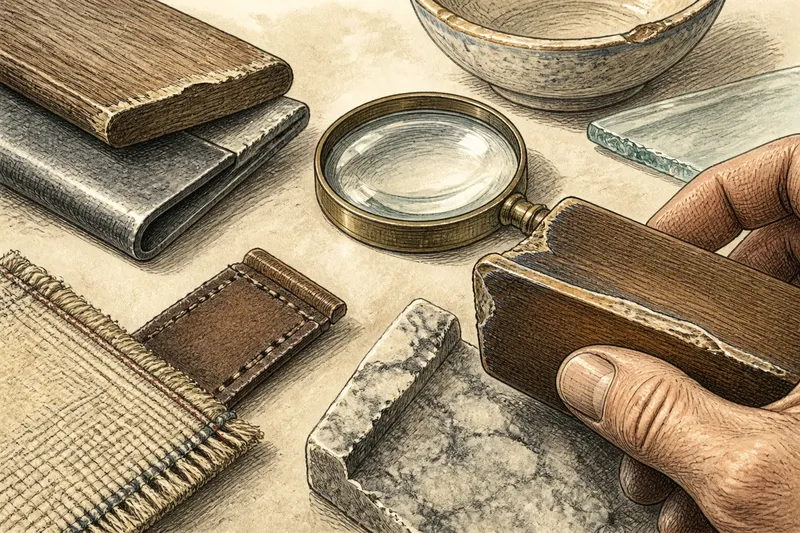
Paper usually keeps the overall impression light and can echo the thinness of printed matter, tissue, or torn book pages. Cloth brings a visible weave and a softer, less rigid character, even when the pieces above it are paper. Card or board gives the work a firmer visual presence and makes exposed margins read as deliberate borders rather than incidental backing.
Tuesday tests texture without asking it to behave
Look closely at the surface under ordinary room light. Smooth paper gives torn fibers and printed marks room to stand out. Textured paper can make a quiet background, but a pronounced grain may also compete with small details. Cloth has its own structure: plain weave, canvas-like texture, and loose fibers each affect how flat scraps appear.
Board varies too. A smooth coated face may contrast sharply with rough handmade paper; an uncoated, toothy face can make the whole composition feel more tactile. Run a fingertip lightly across each candidate, then view it from a few steps away. The first check identifies physical texture; the second shows whether that texture remains part of the composition or disappears into the background.
Choose texture by contrast, not by the assumption that more texture means more interest. If the collage already contains woven ribbon, corrugated fragments, or heavily marked paper, a calmer base can give those details room. If the pieces are mostly flat and uniform, a woven or fibrous ground may provide a quiet counterpoint.
Wednesday checks flexibility and adhesive response
Flexibility changes how the finished collage sits and how easily it can be handled. Paper bends readily, though a light sheet may wrinkle when adhesive adds moisture. Cloth folds and drapes naturally, but its weave can show through thin pasted pieces. Board resists bending and supports a flat arrangement, while its stiffness can make the edge of a collage feel more like a panel.
Make a small trial with the same adhesive and materials intended for the final work. Place one scrap near the center and another close to an edge, then apply adhesive as the product instructions direct. Let the sample dry in a protected, flat place. Observe curling, visible adhesive, loosened fibers, or a change in surface color. This is a comparison of materials, not a promise that the larger piece will behave identically.
If a trial warps, the answer may be a sturdier base, a less moisture-heavy adhesive, or a lighter application suited to the materials. If cloth puckers around a paper piece, consider whether that movement adds character or makes the image difficult to read. Do not force the surface into a role it resists; a collage can use a little movement, but accidental buckling rarely clarifies the arrangement.
Thursday studies the edges before the center
Edges are where a surface announces itself. A visible strip of board can frame a composition, while a ragged paper margin can make the transition from image to ground feel loose and exploratory. Cloth edges may fray; that can suit a soft, layered work, though stray threads can distract from small, precise shapes.
Place a few scraps so they stop short of the base’s outer edge, then place others so they overlap it. Compare both arrangements. A consistent border makes the support part of the design. Pieces running to the edge create a more continuous field, but they also make the backing less prominent. Neither treatment is inherently finished; the decision should match the visual rhythm of the scraps.
Think of the surface like a picture frame: it can quietly hold the arrangement, or announce itself as part of what is being seen. Unlike a frame, however, the base may remain visible between every fragment. That makes its color and texture more consequential than the border alone.
Friday compares the three surfaces in one small composition
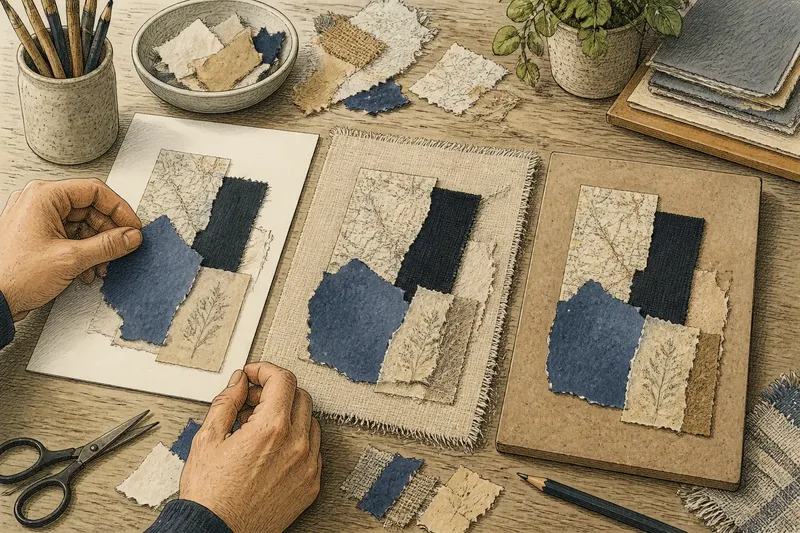
Build the same modest arrangement on paper, cloth, and board. Use identical scraps and keep their positions close enough for a fair visual comparison. The point is not to produce three finished pieces. It is to see which support makes the materials feel coherent without asking the base to imitate something it is not.
Say you have a pale map fragment, a strip of dark cotton, and a torn blue paper shape. On thin paper, the arrangement may feel light, but damp adhesive could make the ground ripple. On cloth, the weave may connect the cotton strip to its setting, while softening the map’s sharp lines. On board, the blue shape may read crisply against a stable ground, and an exposed margin may give the grouping a more object-like presence. These are expected visual possibilities, not results from a test; the actual scraps and adhesive decide the details.
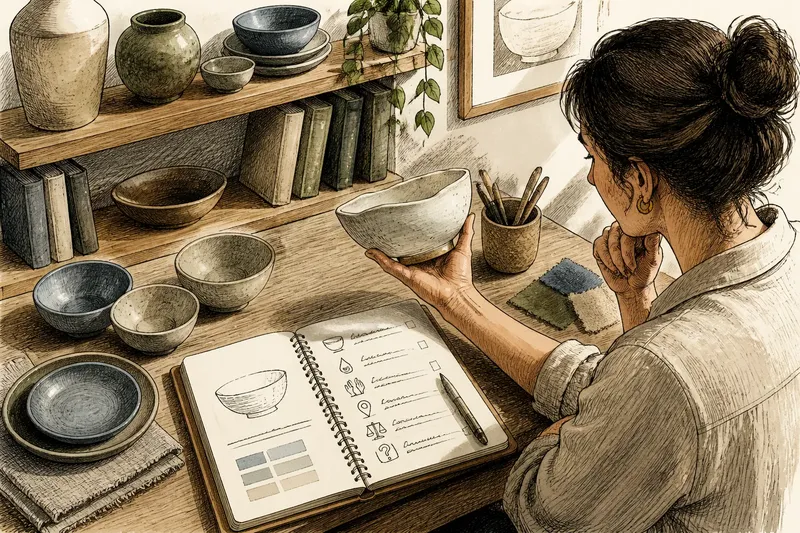
After the samples dry, set them side by side and ask three questions: Does the base support the strongest material, does its texture compete, and do the edges look intentional? A quick pencil note beside each sample can record the answer. Avoid judging only by which version looks most polished; a rougher surface may be the better choice if roughness is part of the collage’s character.
Saturday chooses a surface for the intended character
Use the trials to make a decision, not to search for a universally best material. Paper suits work that depends on lightness, torn margins, or a close relationship between the ground and paper scraps. Cloth suits arrangements that benefit from visible weave, drape, or a tactile softness. Board suits work that needs a steady, firm support or a clearly visible backing edge.
There are useful combinations, too. A piece of fabric mounted on board can retain its woven appearance while gaining a firmer setting, though the added layers change the thickness and edge. Paper attached to cloth can create a sharp-soft contrast, but the trial should show whether the weave interferes with the scraps. A mixed construction is a choice about character, not a way to make every surface behave alike.
Before committing, confirm that the adhesive and surface are compatible according to their labels or manufacturer instructions, and follow any relevant local handling guidance. If the collage is intended for a particular display or conservation setting, ask a qualified conservator for material-specific advice rather than assuming an ordinary craft adhesive is suitable.
Sunday leaves room for the surface to remain visible
Make the final arrangement with the chosen support visible wherever it helps the composition. Resist covering every open area simply because it is available. Empty space lets texture register, gives torn and cut forms a place to sit, and keeps the edge of the support legible.
Once the work is assembled, look at it both close up and from across the room. Up close, check for lifted corners, stray threads, visible adhesive, and places where the support has changed shape. From farther away, check whether the surface still sets the right tone. Paper, cloth, or board should not disappear by default; it should either contribute quietly or be deliberately kept out of sight.
The useful choice of a collage surface is the one that makes its limitations part of the design rather than a surprise at the end. Paper offers a light ground, cloth brings weave and movement, and board makes firmness and border more apparent. A small week of looking and sampling can show which of those qualities belongs with the pieces on your table.