A Museum Visit Built Around One Object
A museum visit built around one object gives a short visit a clear focus, connecting what the gallery label says with the object’s place and history.
The usual mistake on a short museum visit is trying to see every room; the cost is leaving with a list of galleries and no particular encounter. A museum visit built around one object gives your attention a point of return: choose a piece, follow its story through the gallery, and leave with a clearer sense of how it was used and understood.
This is not a demand to ignore the rest of the museum. It is a way to connect an object to the people, practices, and places around it instead of treating it as a handsome item in a case. A ceramic bowl, woven basket, carved figure, or hand tool can each open onto a different part of material culture.
Choose an object with a story nearby
Look for an object whose label or neighboring displays offer context you can follow. A vessel may sit beside examples of the same form from another place; a textile may be shown with information about the occasion for which it was made. The useful choice is not necessarily the largest or most ornate one, but the one with a trail of context attached.
Check whether the gallery provides more than a name and a date. Look for references to makers, users, materials, trade, ritual, domestic life, or changes in use. If a label points toward a broader theme, nearby objects or a wall panel may help explain it.
Choose something you can see without blocking others or leaning against a case. If the view is crowded or the label is hard to read, select another object; museum etiquette is a poor price for a little extra information. Keep the visit bounded by one object and the context directly connected to it.
Follow the object from making to use
Start with what the museum identifies: its name, material, place of origin, maker or community if stated, and intended use. These details are not equally available for every object. A label may identify a community or region without naming an individual maker, and that distinction matters.
Next, ask what the object did in its original setting. A basket might have been used to carry, store, present, or exchange goods; a decorated bowl might have served an everyday meal or a formal occasion. Use the label and related gallery text to narrow the possibilities rather than treating appearance as proof of function.
Then consider how the object reached the museum. The display may explain whether it was donated, purchased, excavated, collected during travel, or transferred from another institution. If the label does not say, leave the route unresolved. An object’s museum history is part of its history, not a footnote that can be supplied by guesswork.
Connect the object to its wider setting
Look for the place and community named in the label, then see how the gallery presents that context. A group of objects may reveal shared materials or techniques; a nearby map may clarify relationships between regions. These connections can explain why a form traveled, changed, or acquired a particular meaning.
Pay attention to the language used for culture and history. Does the museum name a specific community, or use a broad regional term? Does it describe an object as sacred, ceremonial, domestic, or traded, and identify whose account supports that description? A label is a useful source, but its wording reflects choices about what to include.
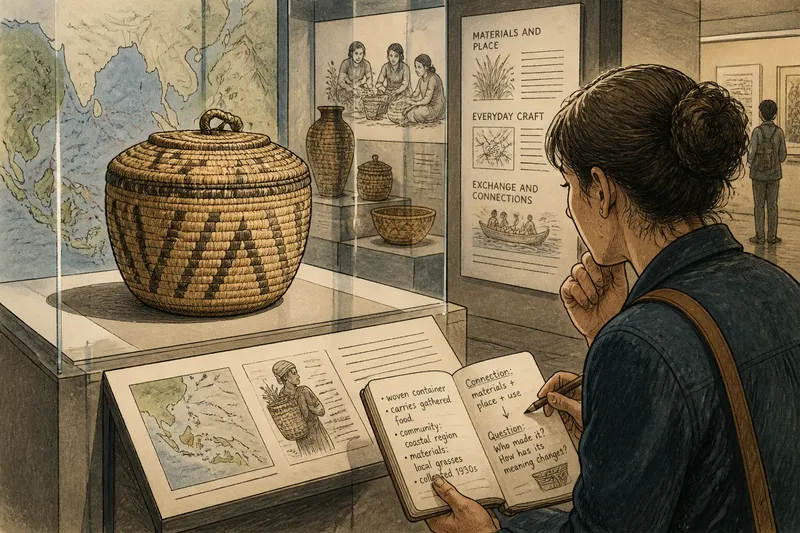
Imagine you choose a woven container whose label identifies a community, its use in carrying gathered food, and its place of origin. You read the neighboring panel, which describes how local materials and exchange shaped everyday craft. You leave with a concrete connection between use, materials, and place, while keeping the maker’s identity open because the label does not name one.
Use labels and gallery texts without treating them as the whole record
Read the object label first, then follow only the nearby text that helps answer a question about use, origin, or museum history. This keeps the visit focused. A long gallery panel may contain valuable context, but there is no requirement to consume it like a contract.
Separate stated information from your interpretation. If a label identifies a material or community, treat that as museum-provided information; if you infer why a particular form was useful, recognize the inference as yours. This distinction is especially helpful when the label leaves out a maker, a specific use, or the circumstances of collecting.
For further context, check whether the museum offers a gallery guide, audio stop, or online collection record. These sources may include additional details or explain why some information is uncertain. If the object’s history raises questions about ownership or collecting, look for the museum’s own policy and interpretation rather than assuming the display tells the full story.
What can you learn from one object?
How do you choose an object for a short visit?
Choose a piece with a readable label and related context nearby. If the display offers no useful background, select another object whose connections you can follow.
What should you look for beyond its material?
Look for stated information about use, maker or community, place, and the object’s route into the collection. If the museum supplies only some of these details, treat the remaining questions as unanswered rather than filling them in.
What if the label gives little historical context?
Check a nearby gallery text or the museum’s collection record for information about use, origin, and collecting history. If those sources remain silent, keep the gap visible; silence is not evidence for a convenient story.
Can one object explain an entire culture?
No single object stands for every person or practice in a community. Use it to learn about a specific material, use, or historical connection, and let the museum’s broader displays complicate that account.
Leave with a connection and a question
Before moving on, name one connection the gallery made clear: perhaps a material linked to a local environment, a form connected to a use, or an object tied to a particular history of collecting. Then keep one unanswered question, such as who made it or how its meaning changed over time. A museum visit built around one object becomes more useful when its limits travel with its discoveries.
If you want to remember the visit, note the displayed name and gallery alongside the connection you learned. Follow the museum’s rules for notes and photography, and respect any access or display restrictions. That small record can help you recognize the same object’s wider story when it appears in another collection or in a discussion of craft and material culture.